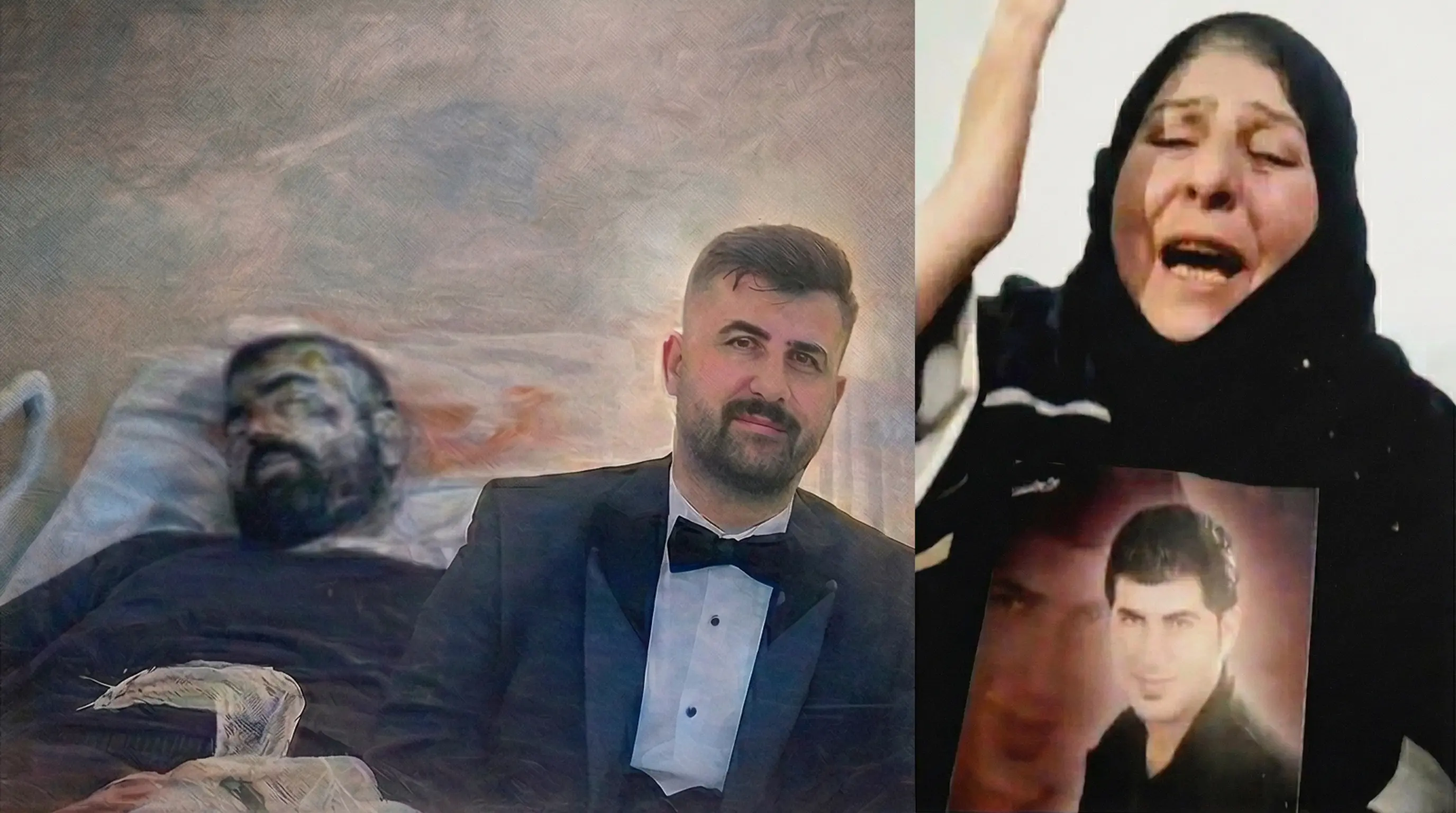
ABDUCTION, TORTURE AND EXTRAJUDICIAL KILLING PERPETRATED BY THE PKK'S SYRIAN BRANCH: ALAAALDDIN ALAMIN
The abduction, torture and extrajudicial killing of Swedish citizen and Kurdish man from Rojava, Alaaalddin Alamin, by the PKK Women's Intelligence Unit
SCOPE, SOURCES AND METHODOLOGY
This report has been prepared by European Kurdish Rights Watch (EKRW). It documents the abduction, torture and extrajudicial killing of Alaaalddin Alamin (born 01.07.1991), a Swedish citizen of Kurdish origin from Rojava, carried out by the PKK Women's Intelligence Unit operating under SDF — the Syrian Democratic Forces, assessed to be the Syrian branch of the PKK terrorist organisation. The report analyses the case within the frameworks of international human rights law, international humanitarian law and international criminal law, and sets out legal findings aimed at establishing accountability.
1.1 Primary Sources
- Interview with the victim's mother, Zainab Mohammed — Rûdaw TV, 09 March 2026
- Interview with the victim's uncle, Ali al-Amin — Welat TV, 09 March 2026
- Interview with the victim's sister, Bushra Alamin — Radio Arta, 09 March 2026
- Handwritten medical/death certificate signed by Dr Faris Hamo, dated 16 January 2026
- Short video footage of SDF vehicles recorded by Bushra Alamin on 20 October 2025
- Open-source reporting and documented patterns relating to the region
1.2 Supporting International Sources
- Amnesty International, 'Aftermath: Injustice, Torture and Death in Detention in North-East Syria' (April 2024)
- UN Commission of Inquiry on Syria, multiple annual reports 2020-2023
- U.S. Department of State 2023 Human Rights Report
- Human Rights Watch, 'Under Kurdish Rule' (2014)
- Syrian Network for Human Rights (SNHR) 2025 documentation
- Syrians for Truth and Justice (STJ) 2024 documentation
- Reporters Without Borders (RSF) statements and reports
- Analyst Kyle Orton's documented research on PKK assassinations (2012-2014)
1.3 Methodological Note
All claims in this report have been corroborated through cross-referencing with multiple independent sources or are based on credible testimonies. Evidentiary limitations are explicitly noted in the relevant sections. Factual findings and legal assessments are kept distinct throughout the report.
SEQUENCE OF EVENTS AND DOCUMENTED FACTS
2.1 Identity of the Victim and Purpose of Return
Alaaalddin Alamin, born 1 July 1991, is a Kurdish man from Rojava, referred to in some press reports as Alaa Alamin or Alaaddin Adnan Amin. His mother is Zainab Mohammed. He fled Syria due to the civil war in 2014 and subsequently acquired Swedish citizenship. He travelled to his hometown of Qamishli on 7 September 2025, transiting through the Kurdistan Region of Iraq, for the purpose of marriage. He planned to return to Sweden with his wife.
2.2 Abduction: 20 October 2025 — PKK Women's Intelligence Unit
In the late hours of 20 October 2025, an armed group of veiled female personnel arrived at the family home in a two-vehicle convoy. The group, assessed to belong to the PKK Women's Intelligence Unit, identified itself as local security forces (Asayish). Alaaalddin Alamin was taken to the vehicles by force without being allowed to change his clothes or put on shoes. His sister, Bushra Alamin, managed to capture a few seconds of video footage of the vehicles.
Local security authorities subsequently reviewed this footage and acknowledged that both the vehicles and the personnel belonged to them. They nonetheless claimed to have no knowledge of Alamin's whereabouts. This contradiction is a clear indicator of an institutional denial mechanism and deliberate concealment of information.
2.3 Six Months of Disappearance and Family Anguish
For approximately six months following the abduction, no information was received about Alamin. His mother Zainab Mohammed and other family members approached authorities, human rights organisations and various institutions, but received no information from any of them. This period reflects the most severe form of enforced disappearance practice.
2.4 Return of the Body: 8 March 2026
On 8 March 2026, Alamin's father was called from a Swiss telephone number and invited to the city of Hasakah, the administrative centre of the SDF. Upon arriving, he received another call from a different number informing him that his son's body was at a hospital. When the family received the body, it was covered in bruises and in an advanced state of decomposition, indicating that death had occurred long before the handover.
2.5 Falsified Death Certificate and Concealment
The official document provided to the family, signed by Dr Faris Hamo and dated 16 January 2026, records the cause of death as a heart attack. This date corresponds to approximately 50 days before the family was notified on 8 March 2026. The profound gap between the stated date of death and the date of notification strongly indicates a deliberate cover-up strategy: the body may have been held to allow decomposition to erase evidence of torture.
2.6 Forensic Findings: Evidence of Torture
Independent physicians engaged by the family found that the body bore severe signs of torture. Indicators of physical abuse were identified in multiple areas of the body, and a perforation was found in the skull. These findings directly refute the official finding of death by heart attack and point to an extrajudicial execution following systematic violence.
2.7 A Critical Detail: The Swiss Telephone Number
A particularly striking element of this case is that the father was contacted from a Swiss telephone number from within SDF-controlled Syrian territory. The identity of the person or organisation that made this call remains unknown. Which PKK-linked network or individual based in Switzerland coordinated this communication? Which European actors had advance knowledge of operations in Syria? Swiss and Swedish security services are obligated to investigate these questions urgently.
REGIONAL CONTEXT: INDEPENDENT FINDINGS OF INTERNATIONAL ORGANISATIONS
The Alaaalddin Alamin case forms part of a well-documented pattern of serious human rights violations in north-east Syria. Multiple independent international organisations have recorded systematic torture, arbitrary detention and political repression in SDF/PKK-controlled areas.
3.1 Amnesty International: April 2024 Report
Amnesty International's April 2024 report 'Aftermath: Injustice, Torture and Death in Detention in North-East Syria' comprehensively documents the pervasive and systematic use of torture in SDF detention facilities. The report contains credible testimonies of detainees being denied legal representation, torture-extracted confessions being used as primary evidence in proceedings, and families being kept uninformed of their relatives' fates for extended periods.
3.2 UN Commission of Inquiry on Syria: Annual Reports 2020-2023
The UN Commission of Inquiry on Syria independently corroborated torture methods used in SDF facilities across multiple annual reports spanning 2020-2023. The documented methods include:
- Shabeh: prolonged suspension by the limbs
- Severe beatings with hoses and cables
- Electric shock
- Burning of body parts
- Sexual violence
These methods are directly consistent with the injuries documented on Alaaalddin Alamin's body.
LEGAL ANALYSIS AND INTERNATIONAL LAW FRAMEWORK
4.1 Prohibition of Enforced Disappearance
The documented facts fall squarely within the international legal definition of enforced disappearance. Article 2 of the International Convention for the Protection of All Persons from Enforced Disappearance (2006) defines this as the deprivation of liberty by state or state-like actors, followed by refusal to acknowledge the deprivation or to disclose the fate of the person, thereby removing them from the protection of law. The Alamin case satisfies all three elements: arbitrary detention, institutional denial, and six months of information concealment.
4.2 Prohibition of Torture and Inhuman Treatment
The severe torture marks identified at autopsy and the perforation in the skull establish a violation of the absolute prohibition of torture, inhuman or degrading treatment under Article 1 of the UN Convention Against Torture (1984). The prohibition of torture is an absolute rule admitting of no exceptions in international law (jus cogens).
4.3 Violation of the Right to Life and Extrajudicial Execution
The forensic evidence strongly indicates that Alaaalddin Alamin's death resulted from systematic violence without any judicial process. Article 6 of the International Covenant on Civil and Political Rights guarantees the right to life. The production of a falsified death certificate and the withholding of the body for 50 days are critical indicators that this violation was deliberate and premeditated.
4.4 Production of Falsified Official Documents
The preparation of the official death certificate signed by Dr Faris Hamo — recording the cause of death as a heart attack to conceal the truth — constitutes the independent criminal offence of document fraud, extends criminal liability and indicates institutional cover-up.
4.5 Sweden's Consular Protection Obligations
Alaaalddin Alamin's Swedish citizenship gives rise to legal obligations for the Swedish state under Article 36 of the Vienna Convention on Consular Relations (1963). The SDF authorities' denial of the detention meant that these obligations were entirely unmet.
4.6 International Criminal Law Dimension
When the documented facts are considered together, and in the context of the systematic repression directed at the Kurdish population in Syria, the acts in question may satisfy the elements of crimes against humanity within the meaning of Article 7 of the Rome Statute.
SYSTEMATIC PATTERNS: PKK'S POLICY OF VIOLENCE AGAINST KURDS
The Alaaalddin Alamin case is not an isolated event. It is the latest link in a deeply entrenched and systematic policy of violence applied by the PKK — an organisation with a 50-year operational history — against Kurds who refuse to submit or integrate into its structures.
5.1 Political Repression: A Systematic Pattern Spanning More Than a Decade
Since HRW's 2014 report, political repression has continued as a broad policy targeting opposition party members, activists, journalists and ordinary citizens who resist incorporation into PKK structures. Analyst Kyle Orton documented 40 assassinations attributed to the PKK between 2012 and 2014.
PKK'S NETWORKS IN EUROPE AND THE THREAT TO CIVIL SOCIETY
6.1 Covert Organisation under Legal Cover
The PKK terrorist organisation has organised across Europe for decades through legally incorporated entities such as cultural associations, aid organisations, media outlets and political lobby structures. Germany, the United Kingdom, Sweden, the Netherlands and Belgium, among others, have designated the PKK as a terrorist organisation; however, comprehensive investigation of the entire European network remains inadequate.
6.2 The Swiss Telephone: The European Connection
A particularly striking element of this case is that the call informing Alamin's father of his son's body was made from Swiss-registered telephone to SDF-controlled Syrian territory. Swiss and Swedish security services are obligated to investigate these questions urgently.
DEMANDS AND RECOMMENDATIONS
7.1 To the Government of Sweden
- An independent and comprehensive criminal investigation into the death of Alaaalddin Alamin must be opened immediately.
- Diplomatic channels must be actively engaged against SDF/PKK authorities, demanding accountability.
- All family members — including Zainab Mohammed (mother), Ali al-Amin (uncle) and Bushra Alamin (sister) — must receive state support, legal representation and psychological assistance.
- All evidence, including video footage, the falsified death certificate and independent forensic reports, must be secured and transmitted to international authorities.
7.2 To the Swiss Authorities
- The Swiss telephone number used to contact the family regarding the body, and its organisational network, must be investigated.
- An investigation into any PKK-linked coordination activities on Swiss territory must be opened.
7.3 To the UN and International Bodies
- The UN Working Group on Enforced or Involuntary Disappearances must be informed and called upon to act on this case.
- The UN Commission of Inquiry on Syria must continue to include violations by PKK forces within the SDF against civilians within its investigation mandate.
- The UN High Commissioner for Human Rights must explicitly condemn this case and demand accountability.
7.4 To European Human Rights Institutions
- The Council of Europe must formally place PKK-sourced human rights violations in Rojava on its agenda.
- The European Parliament must establish a special committee to directly investigate the human rights situation in Rojava and the PKK's pressure networks targeting the European diaspora.
7.5 To International Human Rights Organisations
- Amnesty International and Human Rights Watch must include this case as an additional case in their existing investigation agendas.
- EKRW will continue to transmit this report to all relevant organisations and to keep the case on the agenda at international platforms.