
ORGANIZED HATE SPEECH AND THREATS OF VIOLENCE AGAINST INDEPENDENT KURDISH INTELLECTUALS: THE CASE OF NECAT ZANYAR
The widespread hate speech, threats, and digital violence campaign violating the law by PKK and its affiliated structures against Kurdish intellectual, author, and jurist Necat Zanyar
1. INTRODUCTION
This report documents the systematic hate speech, targeting, unfounded accusations, and threats of physical assault against independent Kurdish author and intellectual Necat Zanyar.
Necat Zanyar is known as an author with 8 published books, a jurist, and the founding president of the Lausanne Kurdish Institute. He has no membership in any political party and has never served as a civil servant. His book titled Kürt Aklı (Kurdish Mind), published in 2024, has garnered significant attention.
The report analyzes the PKK's authoritarian and totalitarian practices within Kurdish society, its systematic methods of oppression and intimidation, through the case of Necat Zanyar. Organizational pressure is carried out through legal-appearing associations and press organizations in Europe. The following five key data points form the main basis of the report:
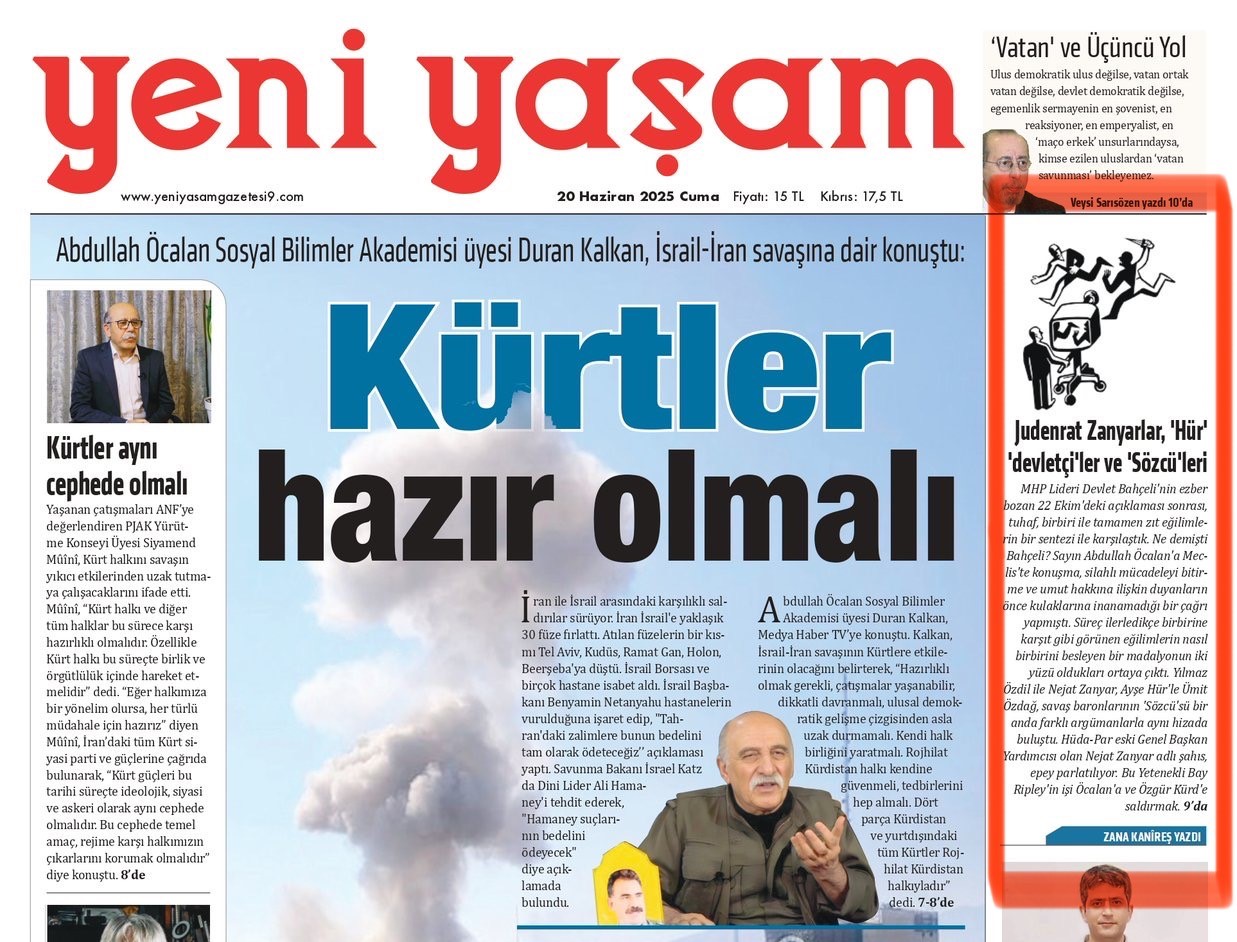
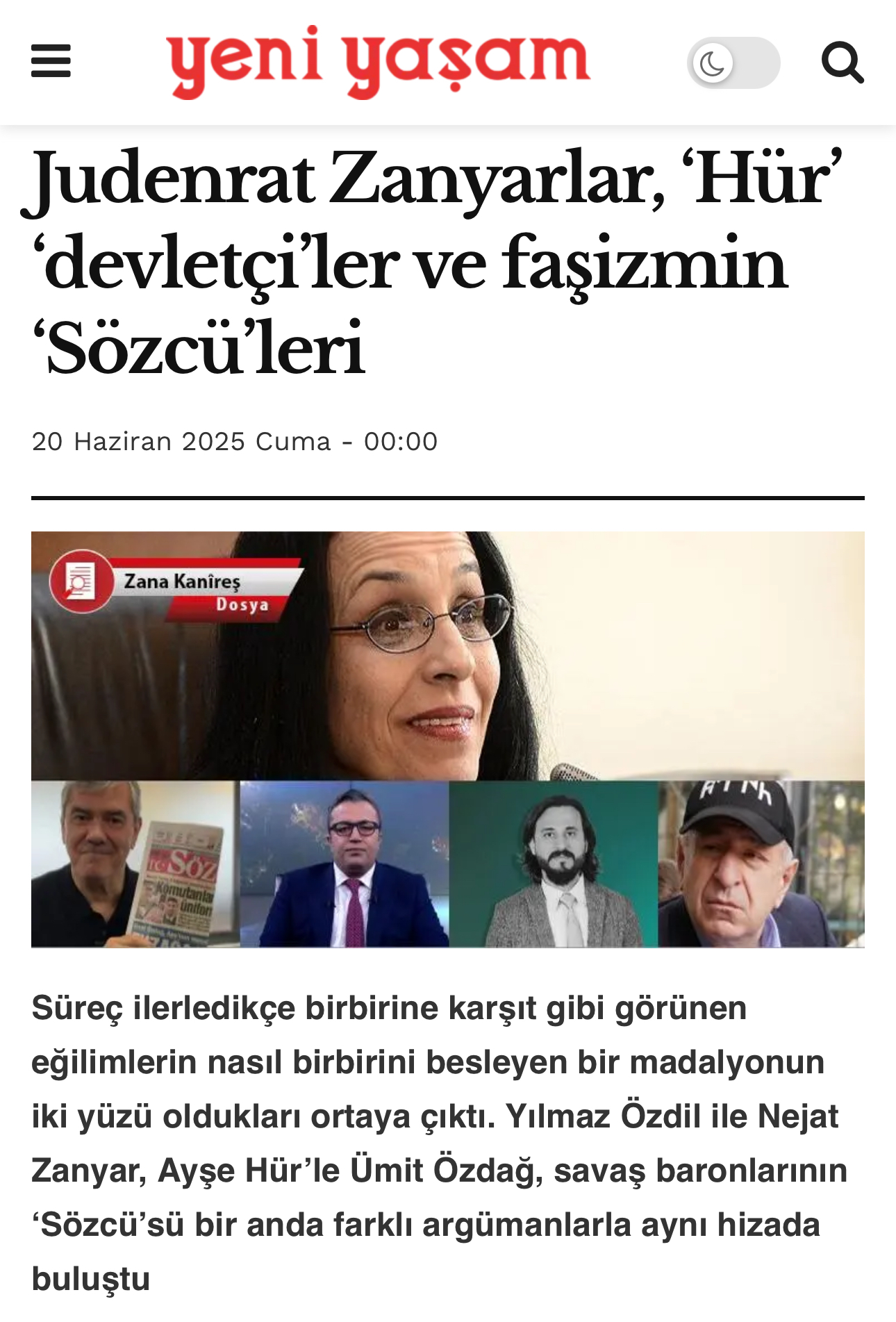
- The article titled "Judenrat Zanyars..." in Yeni Yaşam Newspaper,
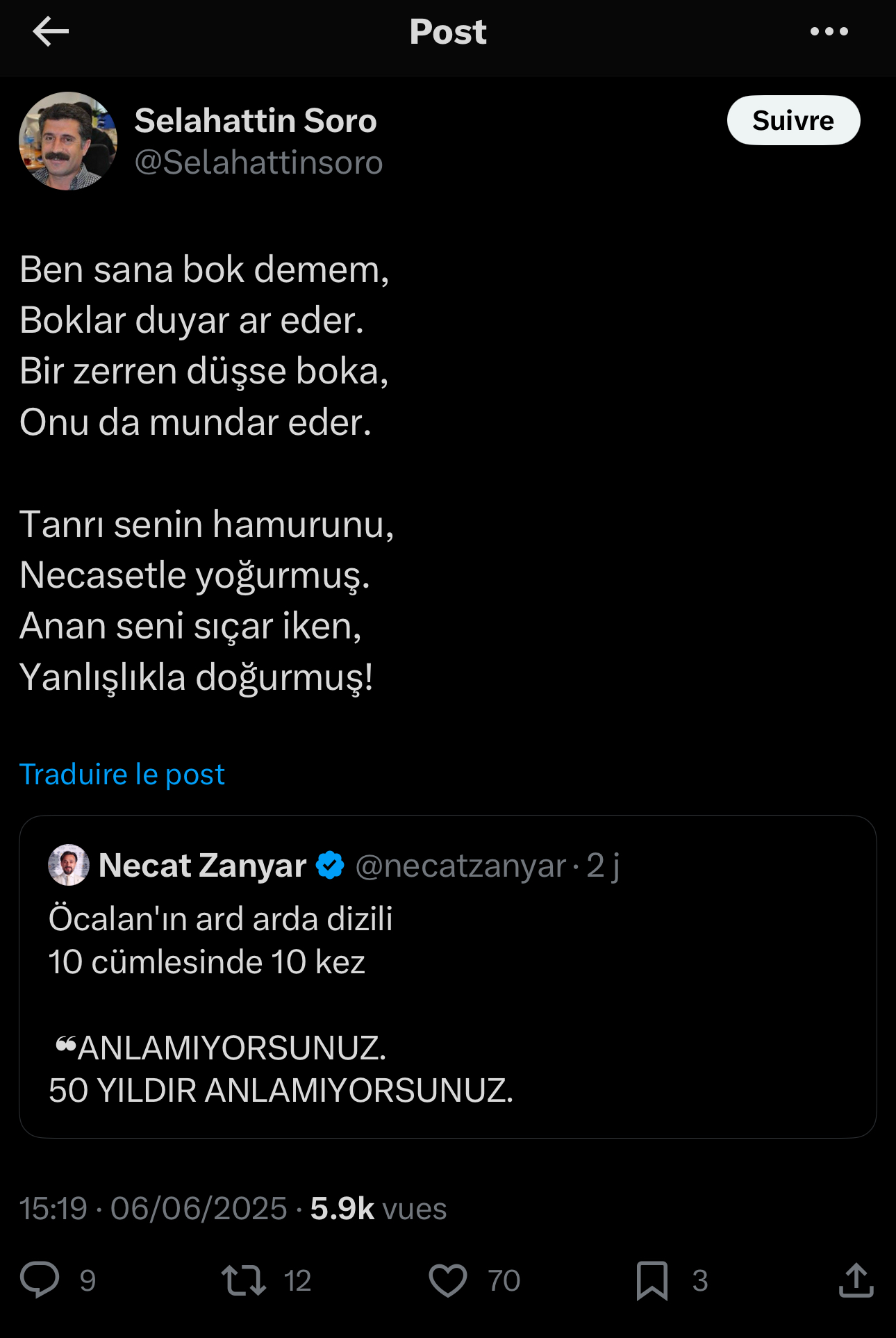
- The targeting post by KNK administrator Selahattin Soro,
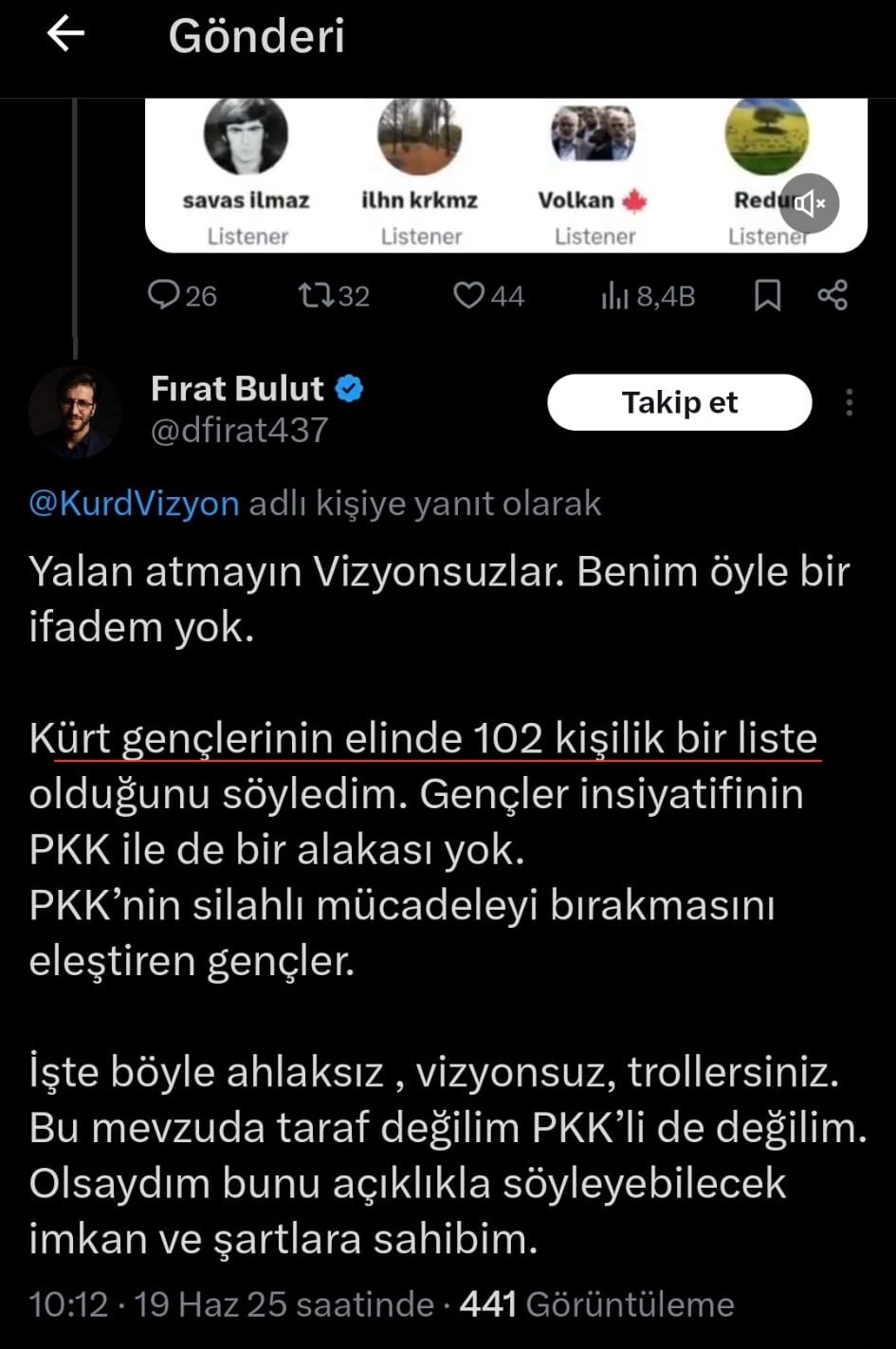
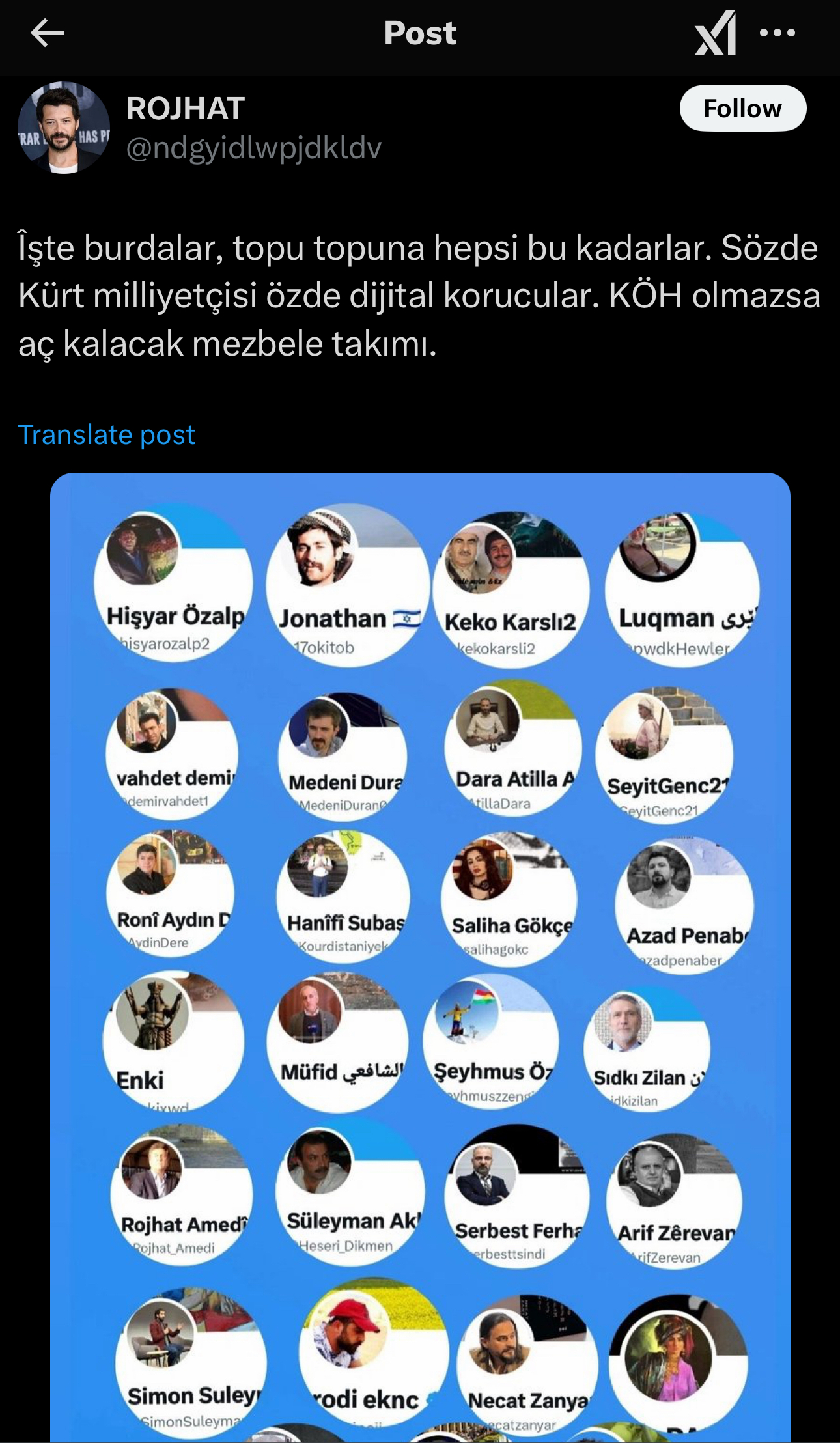
- Fırat Bulut's disclosure of the 102-person "attack list",
- The photo-accompanied targeted persons list published by Azad Ölmez
- Coordinated targeting activities on social media
| Subject | Hate speech, threats, and digital violence campaign by PKK and affiliated structures against Necat Zanyar |
| Prepared by | European Kurdish Rights Watch (EKRW) |
| Date | 17 February 2026 |
Main Institutions to be Submitted to:
- Council of Europe Commissioner for Human Rights
- European Union Agency for Fundamental Rights (FRA – Fundamental Rights Agency)
- European Court of Human Rights (ECHR)
- Office of the United Nations High Commissioner for Human Rights (OHCHR)
- UN Special Rapporteurs and Working Groups
- International Civil Society Organizations and Human Rights Monitoring Mechanisms (Human Rights Watch HRW, Amnesty International, European Centre for Press and Media Freedom ECPMF)
- European Parliament and National Parliamentary Human Rights Committees
- Human rights organizations and judicial authorities of relevant states
2. DATA CONSTITUTING VIOLATIONS AND CRIMES
2.1. Yeni Yaşam Newspaper Article (20 June 2025)
- On 20 June 2025, the PKK-affiliated Yeni Yaşam newspaper published an article titled "Judenrat Zanyars, 'Free' Statists and 'Spokespersons' of Fascism" containing direct insults and targeting expressions against Necat Zanyar.
- The term "Judenrat" used in the title of the article was employed by PKK leader Abdullah Öcalan in his PKK congress text dated 5 May 2025 to mean "traitor," and PKK media began using this expression intensively against dissident Kurds.
- The article, published under a fake author name not among the newspaper's writers, was published as a front-page headline in the printed edition of the newspaper. This situation demonstrates that the article was published under the direction of the criminal organization with the aim of targeting.
- This article equates Necat Zanyar with "Judenrat" members who allegedly played a role in the administration of Nazi-era Jewish concentration camps. This is an exploitation of a historical human tragedy and brands Zanyar not merely as a political rival but as a traitor who "betrayed his people."
- The metaphors "Talentless Mr. Ripley" and "Man of a Thousand Faces" in the article falsely portray Necat Zanyar as a fraudulent, unreliable, and opportunistic character. These expressions carry the purpose of severe discrediting of the target and implying potential violence.
- The expressions such as "Lunatic," "Rotten Soul," and "Guided Personality" in the article severely dehumanize the author Necat Zanyar. This language lays the groundwork for legitimizing any kind of action against the target.
- The text levels severe accusations against Necat Zanyar without presenting any concrete evidence. Zanyar is labeled as a "Special Warfare Agent" in terrorist organization jargon and accused of being associated with a legal political party in Turkey despite having no connection. As a matter of principle, no one can be accused for being a member and administrator of a legal political party. Here, PKK sources are misleading the public with false information.
- Accusing Necat Zanyar in the article of stealing the expression "Kurdish Mind" from Abdullah Öcalan is a deliberate smear attempt aimed at destroying the target's intellectual reputation and originality, rather than an intellectual critique. This also shows that the main reason for the PKK organization's discomfort toward Necat Zanyar is the author's ideas.
- The statement "There is no room for Bekos and Judenrats in the neighborhood of the Free Kurd" in the text is an extremely dangerous and exclusionary discourse. This expression implies that the target should be excluded from society and even that their physical existence is unacceptable. Such "no room" discourses have historically been used before acts of violence. Indeed, in 2015, PKK television director Zana Azadi targeted the former Diyarbakır Bar President Tahir Elçi by saying "How can Altan Tan and Tahir Elçi, who criticize PKK's actions, walk in the streets of Amed," and Tahir Elçi was killed under suspicious circumstances shortly after, on 28 November 2015.
- Throughout the text, Necat Zanyar is defined as a "sworn enemy of Öcalan and the PKK." However, none of Necat Zanyar's 8 published books are about the PKK organization. Only 3-4 of Zanyar's hundreds of articles are about the PKK organization. Despite this, such labeling makes the person a "legitimate" target in the eyes of the organization's sympathizers and justifies any kind of action against them (from verbal harassment to physical assault).
- The article published under a fake author name in the PKK newspaper, since it directly targets an individual, does not fall within the scope of freedom of thought, and has seriously endangered Necat Zanyar's life security.
- This article was published one day after the person named Fırat Bulut exposed the "102-person dissident Kurds list" that the PKK was preparing to attack. In his audio recording statement, Fırat Bulut named "two persons" on the list, stating that he had been exposing one of these two, Necat Zanyar, on his Twitter page for months. While on one hand the existence of a concrete "attack list" is claimed, on the other hand, publications of this kind that humiliate, demonize, and exclude the target from society multiply the risk against the target manifold. This serves as a bridge between verbal violence and actual violence.
- The fact that this article was published not in just any newspaper, but in the propaganda and disinformation newspaper of a criminal organization recognized as a terrorist organization worldwide and known for thousands of brutal murders, demonstrates the seriousness of the matter.
2.2. Targeting by KNK Administrator Selahattin Soro (06 June 2025)
- Selahattin Soro is an administrator of the KNK, which European security agencies classify as the PKK's European umbrella organization, and is also one of the writers of PKK-affiliated media.
- According to some sources, Selahattin Soro is the number one figure of the entire PKK structure in Europe. He is the secret illegal leader of the organization in Europe.
- On 06 June 2025, Soro targeted Necat Zanyar on Twitter/X with severe insult expressions constituting an assault on personal rights, writing: "I won't call you excrement, excrement would be embarrassed... God kneaded your dough with filth. Your mother defecated you and accidentally gave birth."
- This situation means that a person positioned in the organizational hierarchy is directly producing targeting and hate speech. The use of severe expressions contrary to human dignity by an organization administrator demonstrates the institutional dimension of the hate and threat campaign.
2.3. Fırat Bulut and the 102-Person Attack List (19 June 2025)
- Fırat Bulut is a person living in Germany who claims to be a journalist and is linked to the PKK. Bulut conceals which city he lives in and which press organization he works for, but uses the image of a journalist who is an IFJ Global member on social media.
- On 18 June 2025, in an X Space room where he was a speaker, Fırat Bulut announced as "good news" to PKK sympathizers that the PKK had created a list of people it would attack and was waiting for the process in Turkey.
- On 19 June 2025, as Bulut's speech recording spread on social media, Fırat Bulut made many posts about the topic and stated he had exposed two of the listed persons on his page. One of these two persons is the author Necat Zanyar. Fırat Bulut had been targeting Necat Zanyar on his page for three months before announcing the attack list, upon which Necat Zanyar filed complaints with the prosecution in Switzerland and Germany.
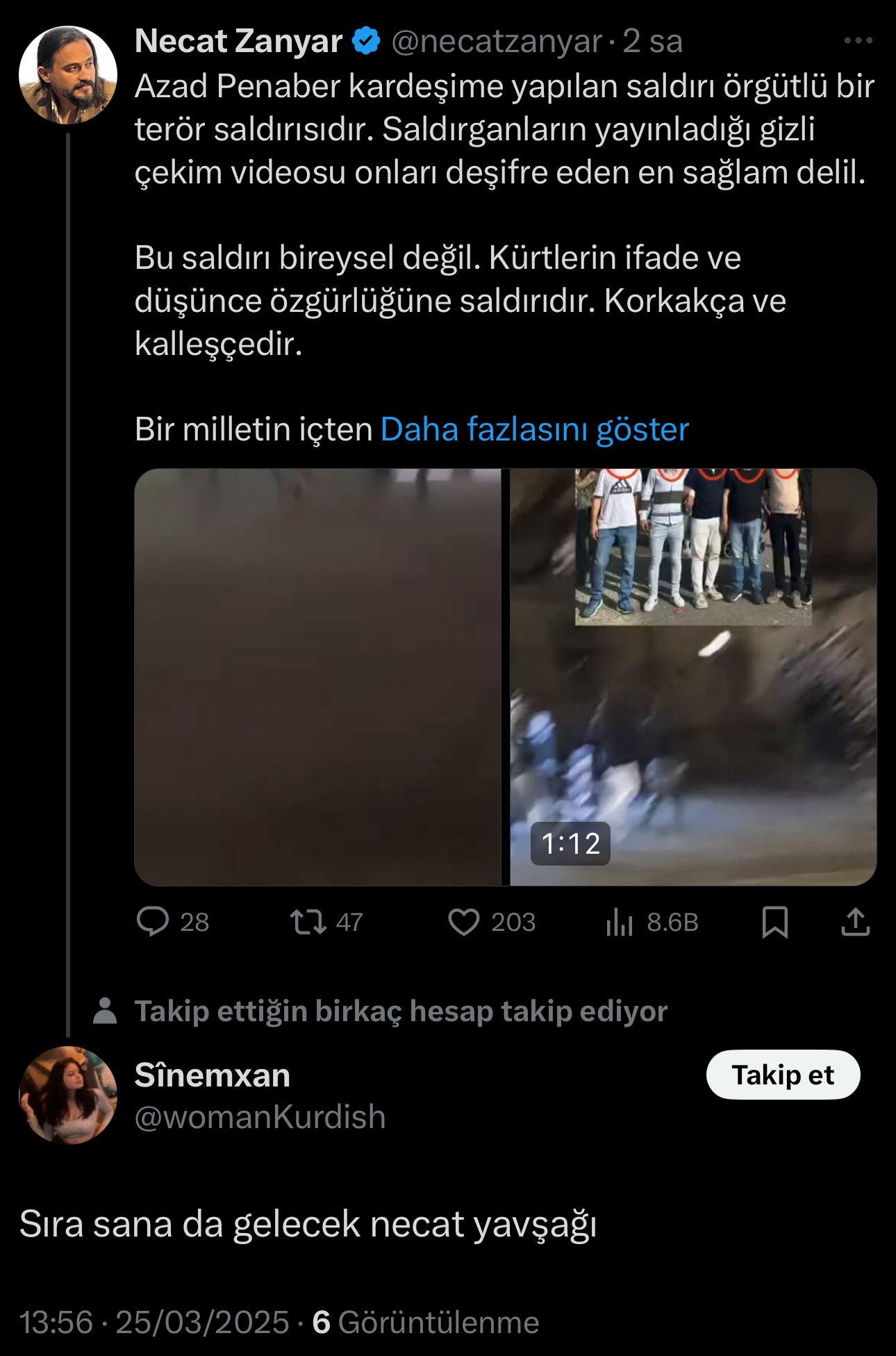
- Fırat Bulut also confessed that the list included photos and was circulated during the period when Azad Penaber was attacked in Lausanne, Switzerland on 23 March 2025. Azad Penaber, who was on the photo list, was physically attacked by a 5-person PKK gang in Lausanne on 23 March 2025, the planned attack was secretly recorded on camera by the organization, and this recording was later published on social media.
- After exposing the attack list, Fırat Bulut confirmed this in writing on Twitter on 19 June 2025, saying "I said that Kurdish youth have a 102-person list in their hands." However, due to public pressure, in the following days he used denial-oriented expressions such as "The list that came from me has no source... I said the number randomly and unconsciously... I'm distancing myself from this..." (tweet dated 26 June 2025), changed his Twitter account information, and later closed his account.
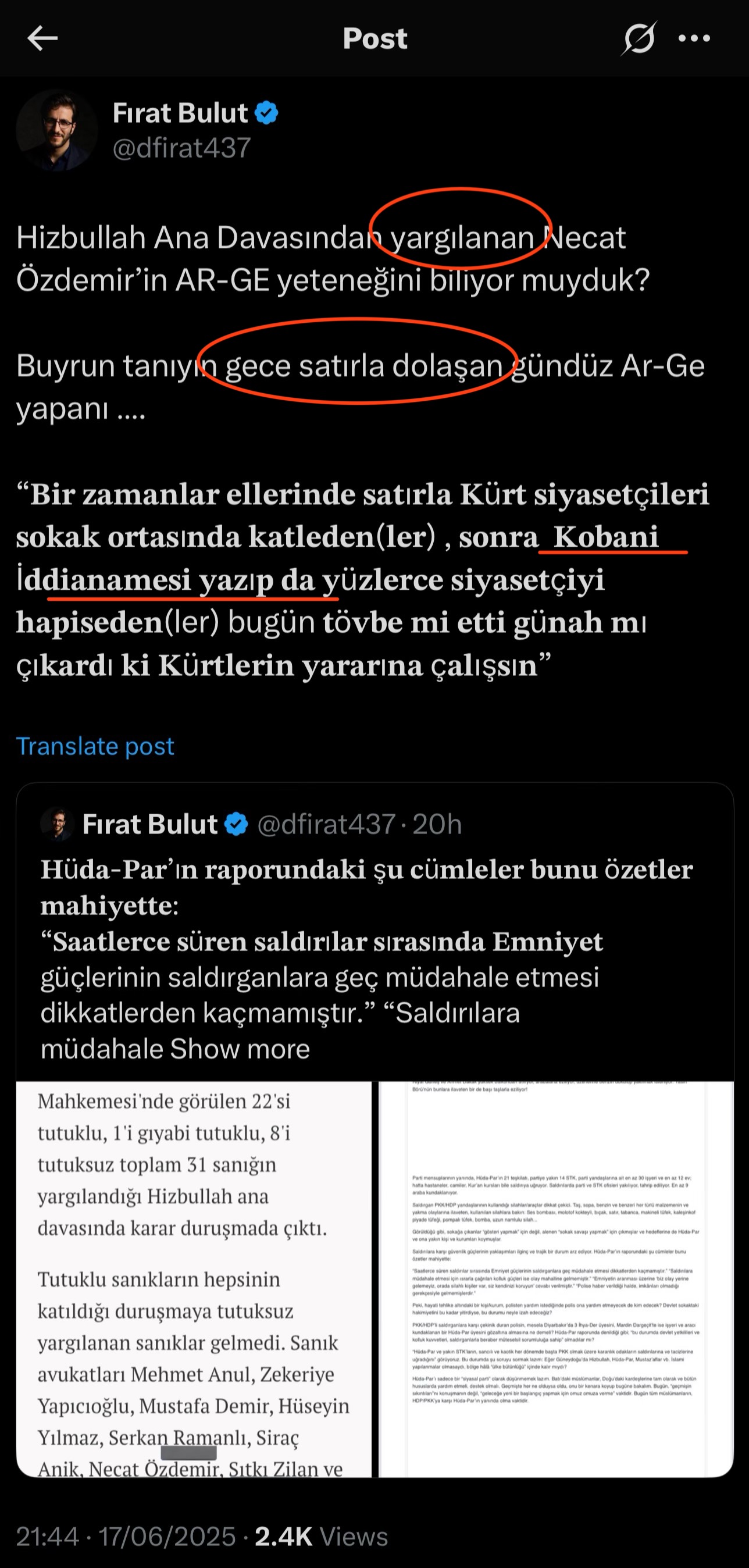
- The PKK-linked person named Fırat Bulut persistently continued to target the author Necat Zanyar with unfounded information throughout this entire process. Bulut targeted the author Necat Zanyar to the PKK masses with grave slanders based on no documents, such as "linked to Turkish intelligence" (tweet dated 13.06.2025), "blood on his hands", "one person but member of three organizations" (tweet dated 06.06.2025), "person tried in the main Hizbullah case" (tweet dated 17.06.2025), "person who wrote the Kobani indictment" (tweet dated 17.06.2025).
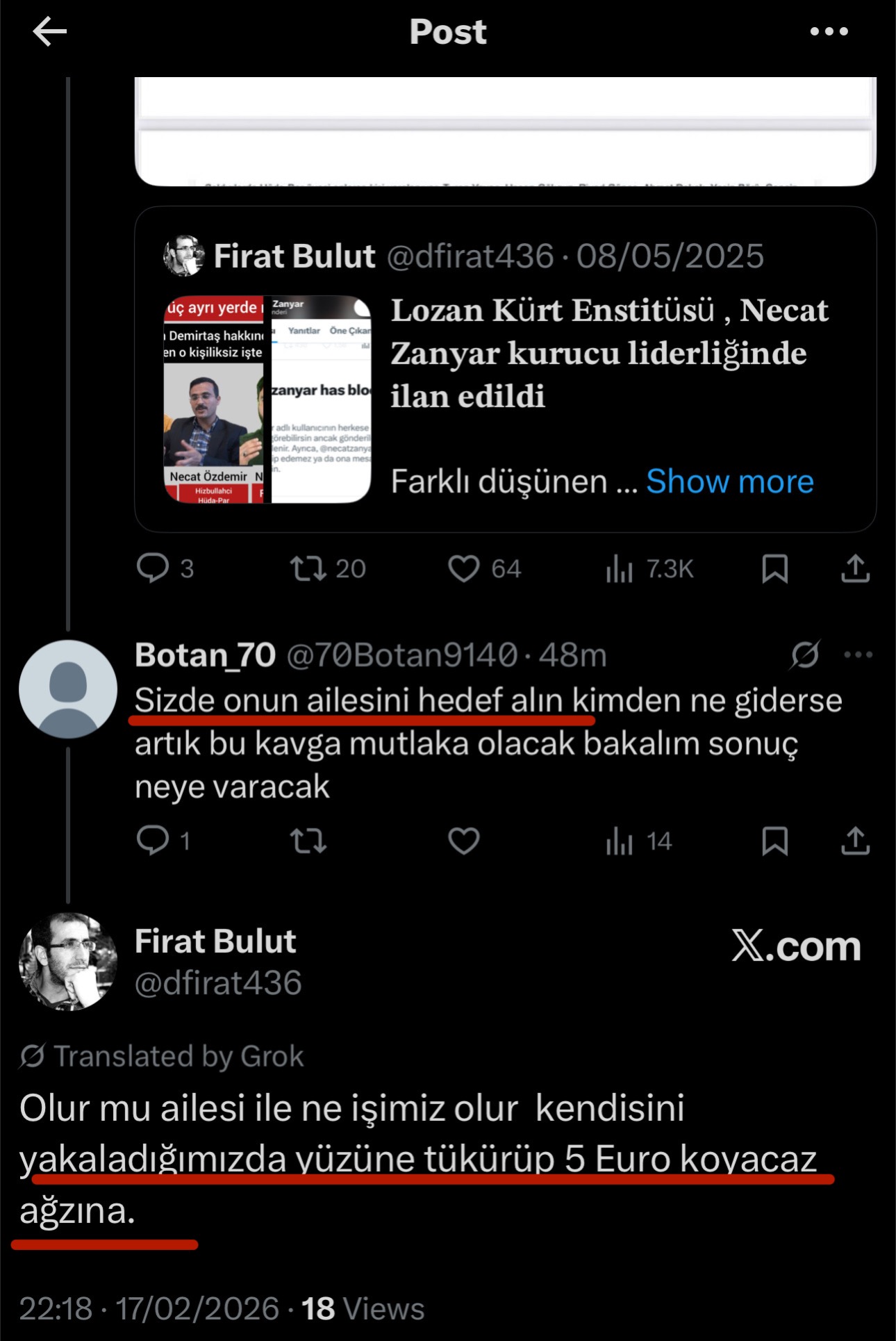
- Fırat Bulut re-shared the same slanders on 17 February 2026 and went further by writing the following threat on behalf of the PKK against the author Necat Zanyar: "When we catch him, we will spit in his face and put 5 Euros in his mouth." With this statement, PKK operative Fırat Bulut clearly referred to the Kurds who were killed by the PKK in the 1990s and had money stuffed in their mouths before being hung on electricity poles, openly committing a crime by saying that a Kurdish author would be killed when caught on behalf of the terrorist organization.
- Investigations have revealed that all writings by the PKK-linked person named Fırat Bulut about the author Necat Zanyar are baseless information pollution lacking any foundation, and contain elements of direct incitement to violence and threats.
2.4. The Photo-Accompanied Targeted Persons List Published by Azad Ölmez
- Azad Ölmez is a PKK member living in Vienna, Austria. As understood from his Twitter/X account information, he is one of the administrators of the PKK criminal organization's digital threat and disinformation group.
- This person opened an X account in February 2026 under the name Azad Ölmez (@poligon47720) with his own photo, writing Cihangir Yıldırım (Senger) at the top of the account. The account's bio also included "Vienna University film and media studies." The same page stated his origin as "Turkey Şırnak Cizre." This person later changed the account handle to @azadolmez_cizre.
- At the date of publication of our report, the X account handle was identified as @azadolmez_cizre, but it was observed that the Cihangir Yıldırım (Senger) text and the Vienna University information in the profile header had been removed, replaced with the same sentence "In nature, everything prevails by striving..." from the bios of accounts under the name Cihangir Yıldırım that he used in 2025.
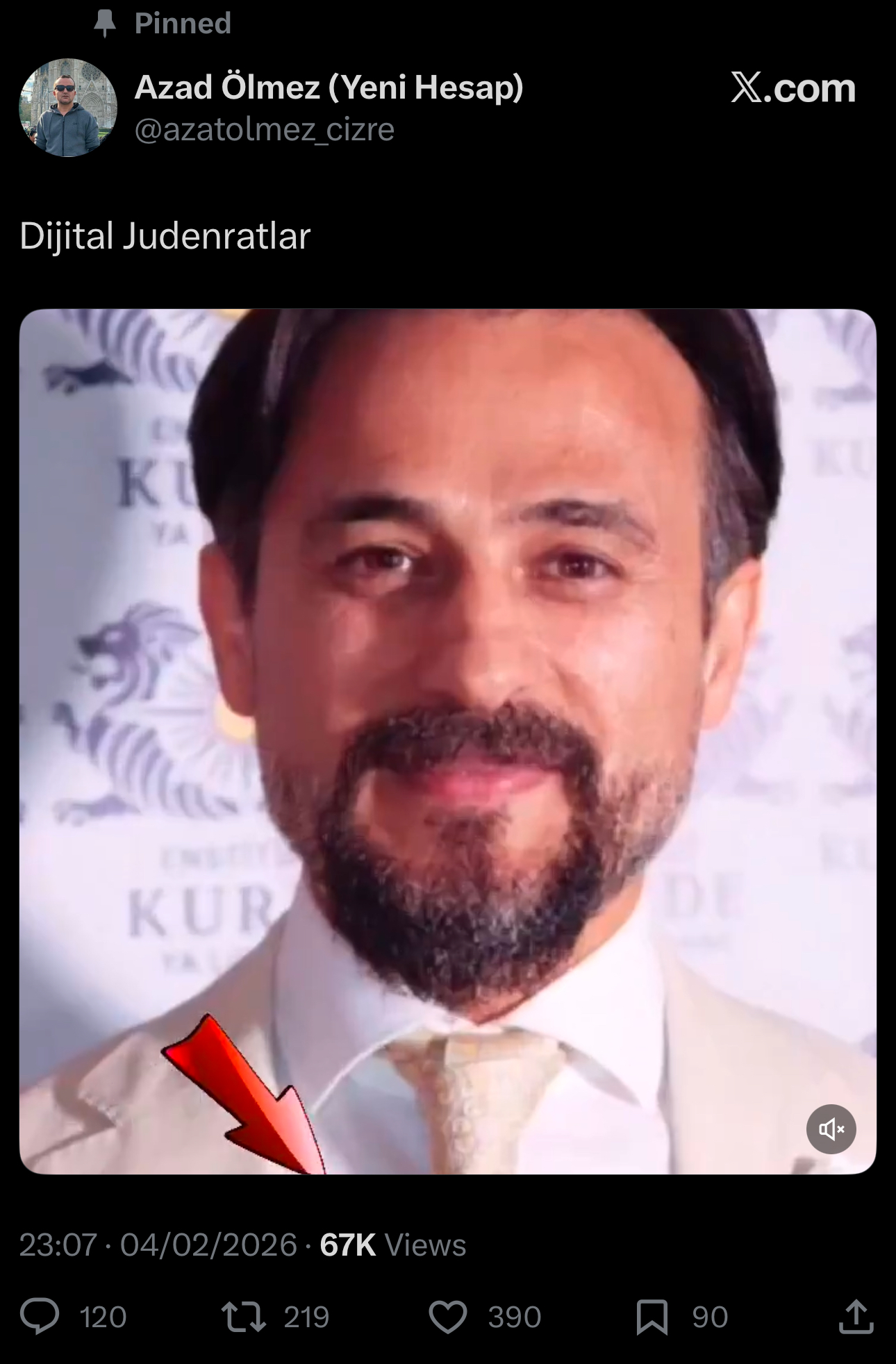
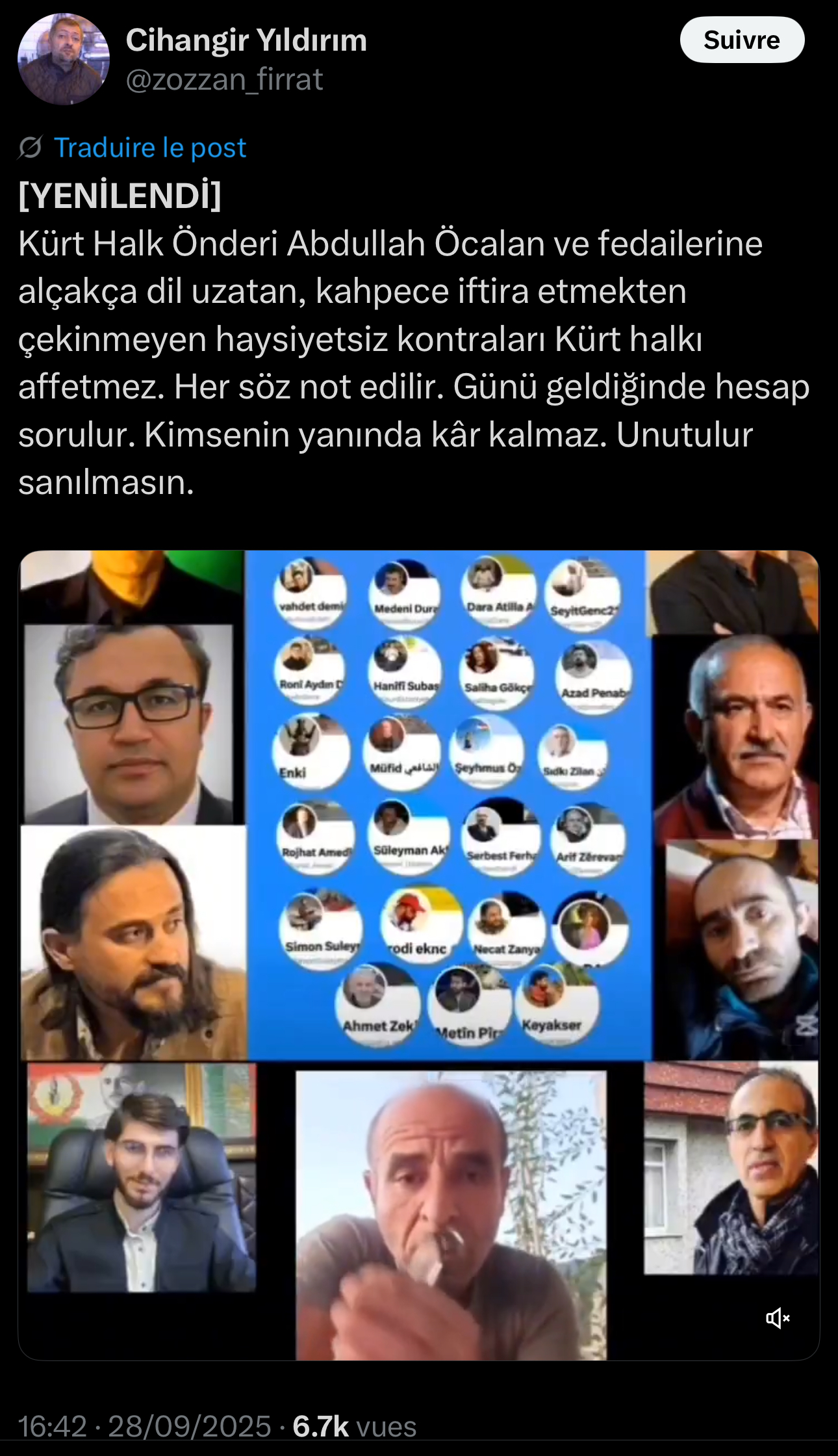
- After opening this X account, Azad Ölmez published on 04.02.2026 a video with photos and audio titled "Digital Judenrats" about targeted Kurdish writers and activists, in which the author Necat Zanyar's photo appeared in first place.
- In this video, the photo-accompanied targeted persons list announced by PKK member Fırat Bulut on 19.06.2025, in which Necat Zanyar's photo was prominently featured, was included again.
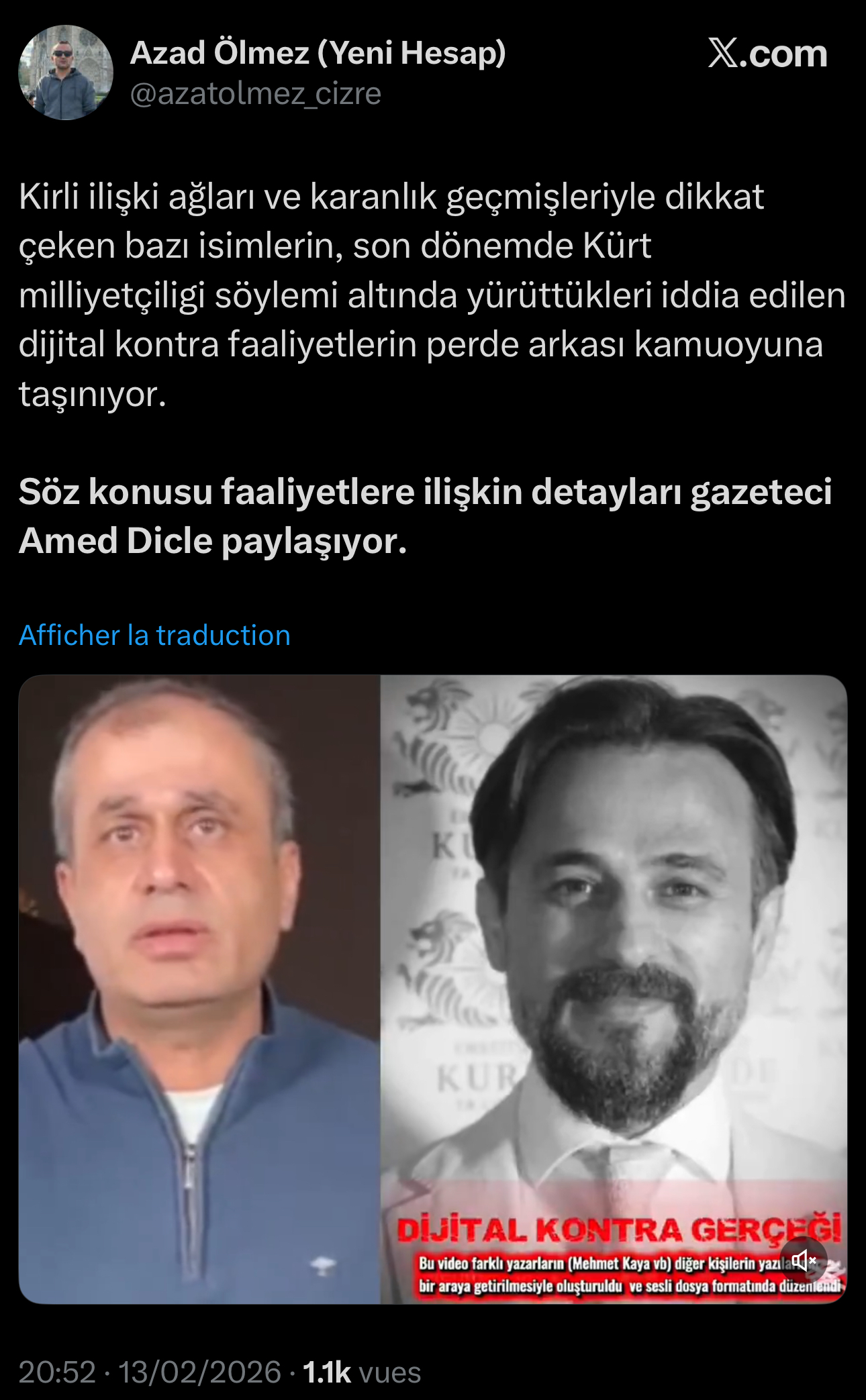
- Through the same account, on 13 February 2026, Azad Ölmez published a speech by the person using the fake name Amed Dicle, who is a PKK media director and whose real name is assessed to be Vahdettin Tayfun, edited together with the photo list of the author Necat Zanyar and other targeted persons.
- The Azad Ölmez account was used solely as an account publishing videos about targeted persons. From this account, the PKK propaganda press ANF, YENİ YAŞAM, and the PKK member named Sedat Ulugana who targeted Necat Zanyar with various disinformation in previous years were also shared.
- Investigations revealed that the PKK criminal organization member named Azad Ölmez published, on 28.09.2025 through the account Cihangir Yıldırım (@zozzan_firrat), the list of persons targeted by the PKK organization with Necat Zanyar's photo prominently featured, accompanied by severe insults and threat expressions. The following expressions were used in the said post: "The Kurdish people will not forgive the dishonorable contras who vilely slander the Kurdish people's leader Abdullah Öcalan and his devotees. Every word is noted. When the day comes, accounts will be settled. No one will go unpunished. Let it not be thought that it will be forgotten." All these expressions contain physical threats in Turkish. It is understood that this threat was made not individually but on behalf of the PKK criminal organization.
2.5. Social Media and PKK Troll Pages
- There is a widespread troll network on social media directed by the PKK criminal organization. The organization's digital media teams organize through communication networks such as Telegram and WhatsApp and coordinate organized hate attacks.
- Examinations show that the vast majority of troll accounts are managed by persons working in PKK media. Indeed, the author Necat Zanyar has been repeatedly targeted and threatened by persons such as Sedat Ulugana and Selman Aslan from PKK media in previous years.
- It is understood that the vast majority of the smear campaign and threats conducted through fake and troll pages are being continued through troll pages by those who previously attacked with their real identities, for the purpose of concealment.
- The PKK criminal organization, with the widespread disinformation network it has created on social media, ruthlessly attacks anyone who is known among Kurds and criticizes the organization, committing every form of slander, insult, defamation, and threat.
3. UNFOUNDED CLAIMS AND SLANDER CAMPAIGNS
- Necat Zanyar is not a member of any party, community, or organization. Despite this, the PKK and its affiliated media organs systematically accuse him by associating him with various parties and organizations.
- Zanyar has never been tried in Turkey on any charge of organizational membership or organizational propaganda. All existing cases against him in Turkey are freedom of expression cases arising from his writings and speeches.
- PKK media and social media accounts are spreading unfounded claims that Zanyar has had many people arrested, despite the fact that he has no complaint against anyone in Turkey.
- Slanders have been published claiming that Necat Zanyar submitted reports to the Selahattin Demirtaş trial and the Kobani case, despite having no connection whatsoever. Investigations found no report published under the name Necat Zanyar, nor does such a report exist in the Kobani case. Selahattin Demirtaş's name does not appear in Hüda Par's report listing attacks in September and October 2014. No suspect names were included in the report listing events reflected in the media. Despite this, PKK-linked persons and media accounts are committing the crime of slander against the author Necat Zanyar by distorting this report.
- Investigations observed that those in PKK organizational media frequently participated in disinformation activities against the author Necat Zanyar. In this context, PKK member Ferhat Buğday living in Switzerland went so far as to quote a post by Fırat Bulut targeting Necat Zanyar to the organization on 08 May 2025, claiming that Necat Zanyar "even testified as a secret witness in courts." This shows that PKK disinformation sources observe no measure or limit in fabricating lies and slander. For any person to be a secret witness in a PKK file, they must first have been a PKK member or had relations with the PKK. It is known that Necat Zanyar has never had any contact with the PKK criminal organization in any way.
- One of the slanders by PKK media and organization-linked persons about the author Necat Zanyar is the claim that the author used many names. Investigations revealed that nearly all Kurdish authors who write in Kurdish use "Kurdish names and surnames." The author Necat Zanyar used his name as-is in his 5 published Kurdish books and dozens of Kurdish articles, using the word "Zivingî" (his birthplace) as his surname. The author changed his former surname "Özdemir" (a Turkish word) to "Zanyar" (a Kurdish word) through a court case in 2020 and announced this change publicly. The same year he pioneered a surname campaign encouraging Kurds to change their Turkish names and surnames, providing legal support to hundreds of people. The author's Turkish books published from 2020 onward were published under his official name "Necat Zanyar." The fact that PKK media and organization-linked persons characterize Necat Zanyar's use of his village name as a pen name, changing his Turkish surname to a Kurdish word, and pioneering the surname campaign as a crime, emerges as a deep contradiction of an organization claiming Kurdish identity.
- In examinations through the case of Necat Zanyar, it was determined that PKK media and organization-linked persons commit categorical hate crimes by accusing everyone they oppose of being AKP, KDP (Barzanist), Gülenist (FETÖ), Hüda Par (Hizbullah) member. All the mentioned parties and groups have hundreds of thousands, some millions, of followers. There may be criminals in every party and group. However, a category cannot be entirely viewed as an object of hate and criminals. The same applies to the DEM Party that PKK sympathizers vote for. The "demonization," "criminalization" or attribution of "collective guilt" to all members of a social group is evaluated as a form of discourse that constitutes hate speech, discrimination, and potentially lays the groundwork for crimes against humanity. This corresponds academically to "collective guilt attribution," "demonization of a social group," "dehumanization," "stigmatization," and "discriminatory hate speech."
- The International Covenant on Civil and Political Rights (ICCPR), Article 20(2) states "Any advocacy of hatred or discrimination is prohibited." According to the UN International Convention on the Elimination of All Forms of Racial Discrimination (ICERD), Article 4, all forms of hate speech, group hostility, and collective guilt attribution are prohibited. According to the Council of Europe Recommendation on Hate Speech (R(97)20), statements by public actors or media figures targeting specific groups are evaluated as a "pre-violence phase." The widespread generalizations by PKK media through media, demonizing and dehumanizing social groups, constitute a crime against humanity and a call to violence. International human rights law clearly establishes that no group can be collectively defined as guilty or enemy based on their identity.
In the case of the author Necat Zanyar, there are no documents or evidence regarding any of the lies and slanders spread by persons and institutions linked to the PKK criminal organization. All allegations are systematically circulated within the scope of targeting, threats, and hate speech. The fact that the allegations have no connection to reality documents that the PKK has established a mafia-like fear network targeting civilian intellectuals using its European and social media structures.
4. VIOLATED LEGAL PRINCIPLES AND INTERNATIONAL LAW RULES
4.1. International Human Rights Law
- Universal Declaration of Human Rights (1948) - Article 12: "No one shall be subjected to arbitrary interference with his privacy, family, home or correspondence, nor to attacks upon his honour and reputation. Everyone has the right to the protection of the law against such interference or attacks." The organized disinformation activities against the author Necat Zanyar clearly violate this article of the declaration and require the protection of Zanyar against these attacks.
- European Convention on Human Rights (ECHR) Article 2 (Right to Life): Direct targeting and attack threats against Zanyar constitute a violation of the right to life.
- Article 10 (Freedom of Expression): Zanyar's right to free thought and writing is being seriously restricted by hate speech and targeting.
- Article 3 (Prohibition of Torture and Inhuman Treatment): Psychological violence and a continuous threat environment can be assessed within the scope of inhuman treatment.
- Article 8 of the ECHR is the cornerstone of privacy protection in Europe. The ECtHR has broadly interpreted this article to cover physical and psychological integrity, sexual identity, name rights, personal data, and even professional activities. Investigations observed that Necat Zanyar's private life is frequently violated by PKK criminal organization sources.
- The International Covenant on Civil and Political Rights (ICCPR) Article 6 (Right to Life) and Article 19 (Freedom of Expression) have been violated by the targeting and physical attack threats against Zanyar.
- Personal rights require the protection of individuals' honor and reputation, prevention of unauthorized photography, voice recording or publication, and protection of personal data (Council Convention No. 108 and GDPR are the strongest norms in this area). The PKK criminal organization sources systematically attack the personal rights of the author Necat Zanyar.
4.2. International Criminal Law
- Targeting and death threats, especially when made as part of an organized structure (PKK), can constitute examples of systematic persecution that may be assessed within the scope of crimes against humanity.
- Incitement to mass destruction and terrorist acts is part of organized violence plans that constitute crimes under international law.
- The UN Security Council (UNSC) has established a fundamental framework for counter-terrorism by adopting binding resolutions under Chapter VII of the UN Charter. For example, UN Resolution 2178 (2014) on Foreign Terrorist Fighters (FTF) regulates the prevention of those traveling to join terrorist organizations and criminalizes related preparations. The 1999 International Convention for the Suppression of the Financing of Terrorism also criminalizes the provision or collection of funds for financing terrorist acts. It is observed that the PKK, recognized as a terrorist organization in all European countries, freely commits all these crimes in Europe's secure environment.
4.3. Council of Europe and UN Documents
- UN Universal Declaration of Human Rights, Article 3: Right to life, liberty and security of person.
- UN Counter-Terrorism Principles: Threatening civilian individuals and organized hate campaigns constitute crimes within the framework of international counter-terrorism.
5. CONCLUSIONS AND RECOMMENDATIONS
- Intra-Ethnic Discrimination: The hate speech, threats, targeting, and unfounded accusations against Necat Zanyar are a concrete example of the mafia-like fear network that the PKK has established over Kurds. The PKK is a source of "intra-ethnic discrimination" among Kurds and deepens the problem.
- Human Rights Violation: Activities conducted through organizations in Europe and social media constitute violations of international law and human rights.
- To the UN Office of the High Commissioner for Human Rights (OHCHR): A special rapporteur should be appointed for systematic monitoring of hate speech and digital targeting cases in the Kurdish diaspora.
- To the Council of Europe ECRI and OSCE Media Freedom Representative: Content producing hate speech within the Kurdish press should be monitored and reported within the framework of media ethics.
- To national and international judicial authorities: Protective measures should be provided for Necat Zanyar's personal security; the publications in question should be examined within the scope of criminal law.
EKRW has prepared this report for the purpose of documenting the systematic hate, targeting, and slander campaigns against Necat Zanyar, for evaluation by international legal authorities, and for ensuring the safety of Kurdish intellectuals.